Analog Devices’ ADALM-Pluto SDR, while being an overall awesome SDR platform, is famously limited by its USB2 connectivity and clock stability, giving rise to popular forks (Pluto+, AntSDR E200) that include Gigabit Ethernet and a better clock.
On the original board though, while there are many mods available for improving clock stability, including external clock modifications, feeding in a reference clock and a simple U.FL IPEX connector on rev D, there are not many options to alleviate the USB2 bandwidth constraints.
Turns out, the native IIOD wastes 25% of its sample payload throughput on redundant bits.
Wait, what ?
As a quick reminder: SDRs produce complex samples that can be represented as an in-phase component, $I$, and a quadrature component, $Q$.
The PlutoSDR ADC produces 12-bit $I$ and $Q$ values. They are then put into 16-bit words by the HDL (which pads it with 1s or 0s according to the sample’s sign) and shipped via DMA to the IIOD daemon which happily transfers it as is across the USB bus.
That makes an IQ sample use four bytes of payload when its useful data fits in three.
To avoid any ambiguity here, throughput refers to the payload transfered across the USB bus in bits/s, while sample rate refers to complex samples delivered per second, in MS/s (mega samples per seconds).
Theoretically, we should be able to get 33⅓% more samples per second for free, without loss of precision1, at the same sample payload throughput. If our code can keep up.
Bit packing in IIOD
Attempt 1: Naive packing
The first POC packed each pair of little-endian 16-bit I/Q containers into three bytes before sending them. This is the original packing loop:
static inline size_t packed12_pack_scalar(void *dst, const void *src, size_t n) {
    unsigned char *d = dst;
    const unsigned char *s = src;
    size_t j;

    // ...
    for (j = 0; j < n; j += 4, s += 4, d += 3) {
        d[0] = s[0];                      // IIII IIII
        d[1] = (s[1] & 15) | (s[2] << 4); // IIII QQQQ
        d[2] = (s[2] >> 4) | (s[3] << 4); // QQQQ QQQQ
    }
    // ...
}
Note that we naively used batches of $n=4096$ bytes, which after packing gave $3,072$ byte writes.
Performance result: 3.682 MS/s (native 7.241 MS/s). 49.15% lower sample rate than native.
Main problem: Not only did we add the CPU overhead of packing, but we also didn’t reduce the overall number of transfers. In fact given the 25% payload reduction, the sample payload throughput was about 62% lower than native. Ouch.
Attempt 2: Just use larger batches
The packing code stayed the same. The change was to pack and transfer more data per operation rather than issuing many small writes.
#define PACKED12_NATIVE_BATCH 4194304U // We treat up to 4MiB per packing.

// ...
// In the send loop:

if (n > PACKED12_NATIVE_BATCH) {
    n = PACKED12_NATIVE_BATCH;
}
packed12_pack_scalar(thd->packed12_scratch, (char *)start + done, n);
ret = write_all(pdata, thd->packed12_scratch, n / 4 * 3); // Due to our 16->12 bit packing
Note that we don’t wait until accumulated PACKED_NATIVE_BATCH to pack, otherwise the latency would be insane. But at least it should help with keeping the write buffer fed.
Performance result: 7.208 MS/s (native 7.122 MS/s). We’re 95.76% faster than the previous attempt, but still only 1.20% faster than native. Not too much to brag about, but at least it’s not actively worse than native.
Attempt 3: ARM NEON packing and host SSSE3 unpacking
Ok, let’s bring out the big guns: the ARM Cortex-A9 hardcore in the Zynq XC7Z010 does support NEON, so let’s use SIMD to reduce the packing cost by processing 8 IQ samples at once:
uint8x8x4_t in = vld4_u8(s + done);
uint8x8x3_t out;

out.val[0] = in.val[0];
out.val[1] = vorr_u8(vand_u8(in.val[1], vdup_n_u8(0x0f)),
                     vshl_n_u8(in.val[2], 4));
out.val[2] = vorr_u8(vshr_n_u8(in.val[2], 4),
                     vshl_n_u8(in.val[3], 4));
vst3_u8(d + done / 4 * 3, out);
// ... Omitted: call to the scalar impl for the eventual remaining samples if not divisible by 8.
This vectorizes the same 4-byte-to-3-byte mapping by deinterleaving the four input byte streams, applying the same masks and shifts, then writing three interleaved output streams. The host-side also received an x86 SSSE3 unpack implementation because why not.
Performance result: 8.727 MS/s (7.509 MS/s native). +16.22% vs native (over 5 measurements). Yes ! :)
That last result used about 65.5 million samples per run, roughly 8 seconds per measurement.
TL;DR
- Correct scalar packing, but tiny writes: roughly 44–49% slower in short tests.
- Larger batches: approximately break-even.
- NEON pack and host vector unpack: 14.1–29.6% gain across five sustained pairs
Note that these are measurements of TCP over Pluto’s USB Ethernet connection and not iio’s direct USB/FunctionFS.
But why stop here ? Let’s quantize
If we can accept a loss in precision, what’s stopping us from further reducing the payload per sample by quantizing them on the Pluto?
In fact, here is what the payload size landscape could look like:
The payload reduction is per sample; the achieved gain is the measured change in delivered samples per second versus native. The theoretical sample-rate gain assumes the same sample payload throughput: for example, halving the payload per sample could ideally double the sample rate.
| Format | Bits per I/Q pair | Bytes per I/Q pair | Payload reduction | Theoretical sample-rate gain | Achieved sample-rate gain |
|---|---|---|---|---|---|
| Native | 32 | 4 | — | — | — |
| PACK12 | 24 | 3 | 25% | +33⅓% | +16.22% |
| Q8 | 16 | 2 | 50% | +100% | +55.5% |
| Q6 | 12 | 1.5 | 62.5% | +166⅔% | −23.70% |
| Q4 (not tested) | 8 | 1 | 75% | +300% | Not tested |
But doesn’t Soapy already do this ?
Yes, Soapy applications can request a stream format such as SOAPY_SDR_CS16 or SOAPY_SDR_CS8
However, this conversion is done host-side by Soapy. This is why the distinction between application format and wire format matters. An application can request eight-bit samples while the driver receives 16-bit containers and converts them on the host. That saves no link bandwidth. Here, the client and IIOD explicitly select a wire format, and the client reconstructs the expected native layout after receiving it.
Impact of quantization on signal quality
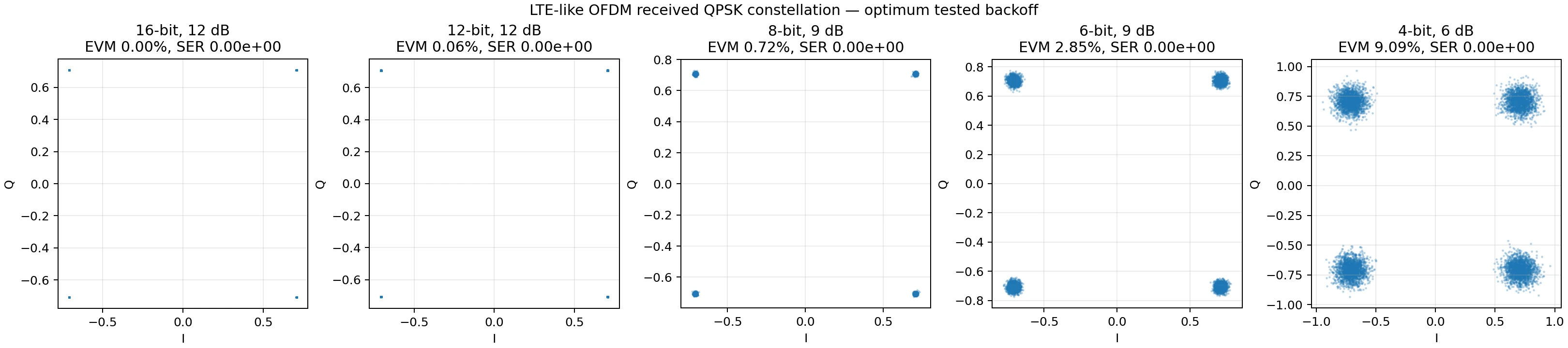
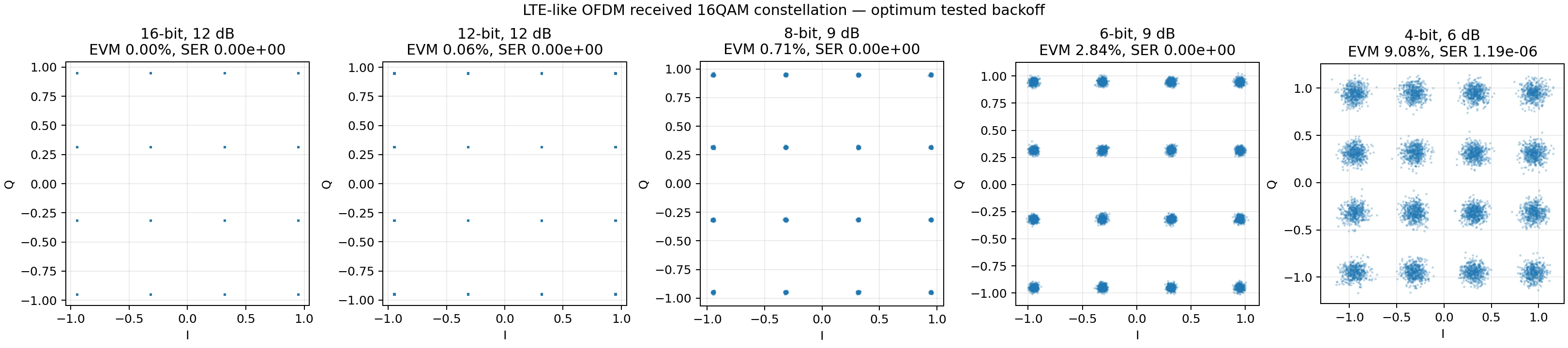
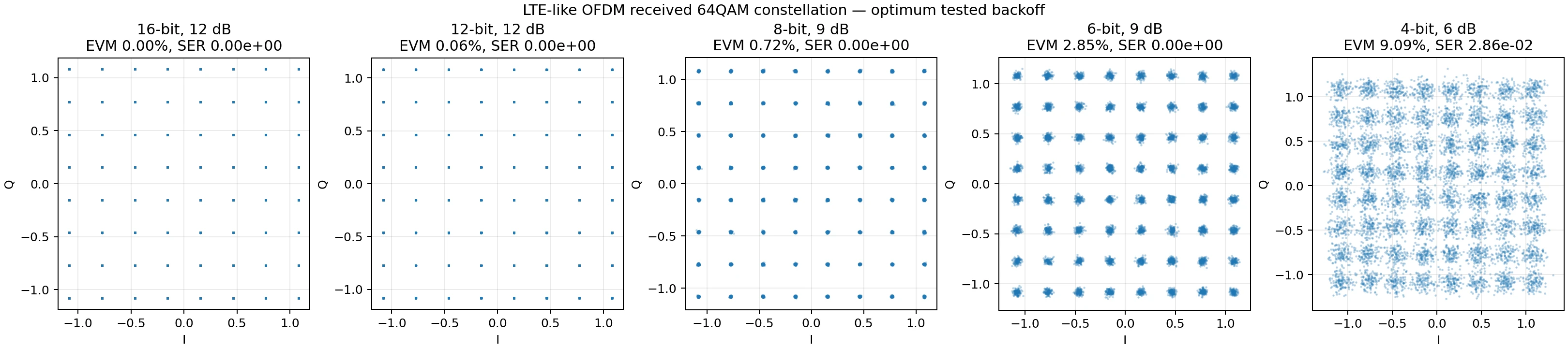
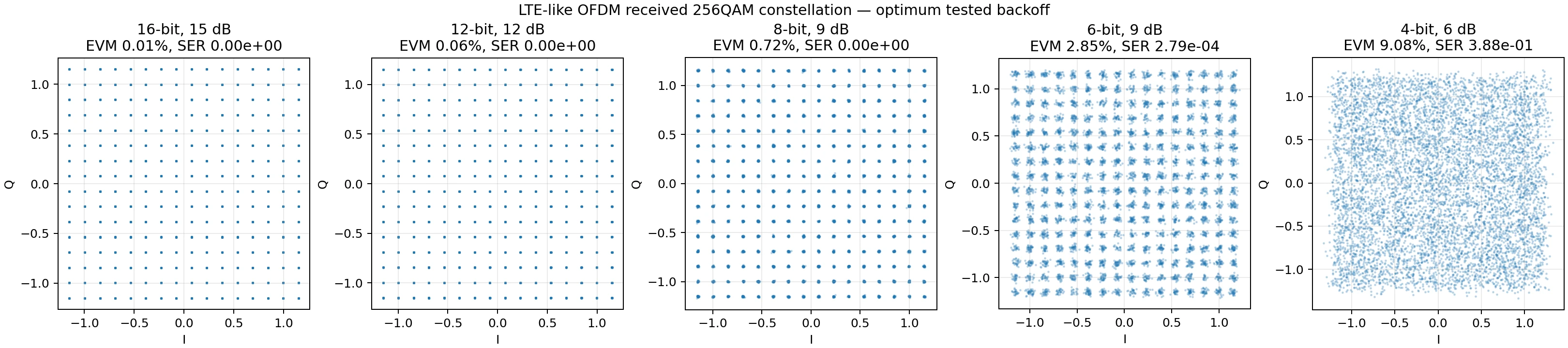
As a toy visualisation of the quantization tradeoff, I used an idealized OFDM model with a 1,024-point FFT, 600 active subcarriers and 2,800 symbols. It uses unit-average-energy QAM, component quantization and one fitted common complex gain after the FFT. This isolates quantization and clipping in the model. Note that this is intended as a visual example and isn’t representative of real world performance at all.
For simulated 256-QAM at 9 dB backoff, EVM was approximately:
| Component width | EVM |
|---|---|
| 12-bit | 0.215% |
| 8-bit | 0.723% |
| 6-bit | 2.848% |
At 12 dB backoff, EVM rose to approximately 0.980% for eight bits and 4.013% for six bits: more backoff reduced clipping but used fewer quantizer levels. Too little backoff has the opposite problem. At 3 dB, 256-QAM EVM exceeded 8% even for the higher-width representations because of clipping.
QPSK
16-QAM
64-QAM
256-QAM
Previous work
Tezuka firmware already offers an eight-bit mode to reduce transport costs.
Its client code enables voltage0 and disables voltage1 to select 8-bit mode, then interprets the incoming bytes as interleaved signed I/Q. This reuses a single-channel IIO selection rather than negotiating a separate wire format: a client expecting one 16-bit component from that selection could misinterpret the data. More importantly for us, this doesn’t allow us to negotiate multiple options for precision.
The project reports stable streaming up to 14 MHz over USB. This is implemented in FPGA.
Tangentially related: a native 8-bit mode was requested for the upstream Analog Devices firmware, but ADI said it was unlikely to implement it because it would require changes across the stack, including HDL.
Performance fun
Once again, we tried the naive scalar way, then ended up using NEON:
- Native copy (no quantization): 44.48 ms median
- Scalar: 272.62 ms median
- NEON: 63.03 ms median
The relevant code is as follow:
__attribute__((target("fpu=neon")))
static inline void wire_pack_q8_neon(
    unsigned char *d,
    const unsigned char *s,
    size_t components)
{
    size_t i = 0;
    const uint16x8_t mask = vdupq_n_u16(4095);
    const int16x8_t bias = vdupq_n_s16(2056);
    const int16x8_t rail = vdupq_n_s16(128);

    for (; i + 8 <= components; i += 8) {
        uint8x16_t bytes = vld1q_u8(s + 2 * i);
        uint16x8_t raw = vandq_u16(
            vreinterpretq_u16_u8(bytes), mask);

        int16x8_t x = vreinterpretq_s16_u16(raw);
        x = vshrq_n_s16(vshlq_n_s16(x, 4), 4);

        int16x8_t q = vsubq_s16(
            vshrq_n_s16(vaddq_s16(x, bias), 4),
            rail);

        vst1_u8(d + i, vreinterpret_u8_s8(vqmovn_s16(q)));
    }

    for (; i < components; i++)
        d[i] = (unsigned char)(signed char)
            wire_quantize12(wire_signed12(s + 2 * i), 8);
}
This is a simple linear rounding with saturation. On the receiver side, we just multiply by 16 to scale it back.
Streaming results
Early stream comparisons showed substantial native-run variability, and one sampler-enabled native run failed after eight measured blocks with -110. The test process was tightened to retain per-block and per-window timing.
The final test campaign used 1,024 measured blocks of 65,536 complex samples, eight warmup blocks and queue depth one. Each leg delivered 67,108,864 measured samples. Those ~30 seconds runs alternated native, Q8, native, Q8:
| Run | Median steady time | Median delivered sample rate | Median sample-rate improvement |
|---|---|---|---|
| Native | 44.43 s | 1.511 MS/s | - |
| Q8 | 28.57 s | 2.350 MS/s | +55.5% |
| Q6 (earlier campaign) | — | — | −23.70% |
Q8’s delivered sample rate was 55.8% higher in the first pair and 55.2% higher in the second. The two native times differed by about 2.2%, and the two Q8 times by about 2.6%.
Q6 was slower than native in every pair: 31.97%, 24.47%, 22.86%, 23.36% and 23.70% slower. More work is needed here.
Conclusion and how to use this patch
PACK12 preserves the 12-bit values and improved the sample rate in every measured pair, though by varying amounts. Optimized Q8 traded precision for roughly 55% higher delivered sample rates in two later pairs. Q6 used the fewest bytes but was slower in the tested implementation and had the largest quantization cost.
This (very) experimental libiio patch is yet to be released pending more work into performance, reliability and general unvibecoding of this proof of concept.
What I think is interesting here is that we didn’t need to touch the Pluto’s HDL to achieve some interesting performance gain, and that we now have a wire-format negotiation mechanism through a libiio context attribute.
Appendix: Selecting a wire format
The experimental branch exposes explicit wire-format tokens:
native
pack12-v1
q8-v1
q6-v1
At the libiio stream level, the experimental API includes calls shaped like:
iio_buffer_stream_set_wire_format(stream, "q8-v1");
Select the format before starting the stream and check the setter’s return value to confirm that it was accepted by the remote.
An experimental SoapySDR integration also accepts a WIRE stream argument2:
setupStream(
    SOAPY_SDR_RX,
    SOAPY_SDR_CF32,
    {0},
    {{"WIRE", "pack12-v1"}}
);
Here WIRE selects the transport representation, while SOAPY_SDR_CF32 describes the application-facing format.
Both the client and IIOD need compatible experimental support; these tokens are not a stock Pluto or universal libiio/Soapy feature.
A non-supported client should fallback on native mode, while a non-supported IIOD on the Pluto is not sent the new selection command: the client returns -EOPNOTSUPP if the iiod,wire-formats context attribute is absent.
Open questions
- Does it work in the real world3, and can support be added to applications?
- Is it upstreamable?
- How does it interact with hardware timestamping?
- Can performance be improved without touching the FPGA?
- Can Q8 be made to work?
In some configurations, the Pluto receive path may produce values outside the signed 12-bit range (FPGA offset addition, driver calibration bias). PACK12 does not preserve those values. The real-world impact is TBD, and further hardening may be required. ↩︎
Note that if the old IIOD behaves properly, we should be able to patch PlutoSoapySDR to ask for the correct wire format for the asked application buffer format. ↩︎
Surely there’s a catch; it can’t be this easy, right? ↩︎